
Updated
6 Task Prioritization Methods
There's no single “correct” way to prioritize — the right method depends on whether you're triaging your own day, scoping a release, or getting a room of stakeholders to agree.
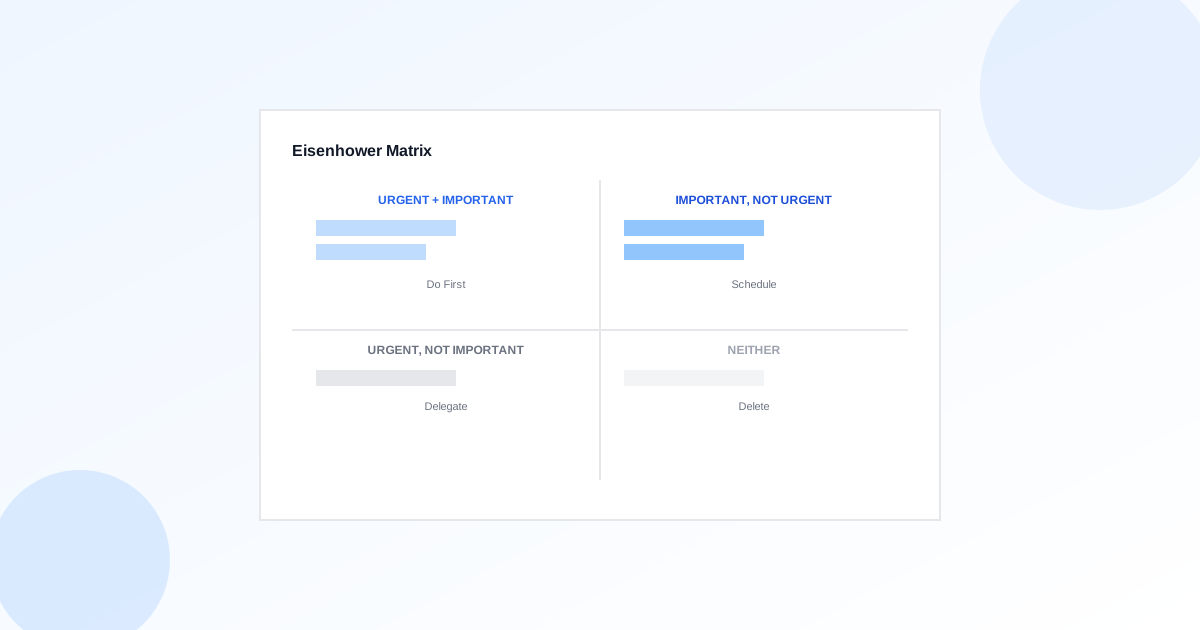
Eisenhower Matrix
Best for: daily triageSort tasks into four quadrants by urgency and importance. Important-and-urgent gets done first; important-but-not-urgent gets scheduled; urgent-but-not-important gets delegated; neither gets deleted. It's fast, requires no tooling, and catches the common trap of treating 'urgent' as a synonym for 'important.'
MoSCoW
Best for: scoping a releaseLabel every requirement Must-have, Should-have, Could-have, or Won't-have (this time). It forces an explicit conversation about what's actually non-negotiable for a release versus what's just nice — which is exactly the conversation most scope-creep problems are avoiding.
RICE Scoring
Best for: comparing competing featuresScore each option on Reach (how many users), Impact (how much it moves the needle), Confidence (how sure you are), and Effort (how costly to build) — then divide (Reach × Impact × Confidence) by Effort. It turns a gut-feel debate into a comparable number, which is most useful when a roadmap has more good ideas than capacity.
ABCDE Method
Best for: personal task listsLabel tasks A (serious consequences if not done), B (mild consequences), C (no consequences), D (delegate), or E (eliminate). Then work strictly in order — never touch a B task while an A task is still open. Simple enough to run without any tool at all.
Now / Next / Later
Best for: communicating roadmap priorityInstead of a precisely ordered backlog, group work into three horizons: Now (in progress), Next (up after this), Later (acknowledged but not scheduled). It's less precise than a ranked list but far easier for stakeholders to read at a glance — and it doesn't pretend to have certainty about things six months out.
Weighted Scoring
Best for: recurring prioritization with multiple stakeholdersDefine the criteria that matter to your team (impact, cost, risk, strategic fit), assign each a weight, then score every task against all of them. More setup than the other methods, but it's the most defensible approach when several people need to agree on priority and gut feel keeps producing disagreement.
Which One Should You Use?
Prioritize Where Your Team Works
My First Task lets you tag priority directly on each task and sort boards by it — no separate spreadsheet required.